February is camellia season (and oh how I love camellia season)
I've always wondered... why does February have to be all about a holiday that makes single people sad and men feel inadequate? In the midst of winter, February is a second chance to surround oneself with bright vibrant colors. The red of Christmas is replaced by the reds and pinks of hearts and flowers. Frilly fancy doilies take the place of paper snowflakes.
I used to mourn the passing of the Christmas and New Year season until I realized that as the Christmas tree was coming down (usually around the second week of January) the hearts and flowers of Valentine's Day could be going up. Such a revelation!
Hubby and I have just as much fun putting up the red and white Valentine decorations on our mantle as we do decorating the mantle for Christmas. We even have a special string of red glass heart lights that we put up so in the long winter evenings they glow with a brilliant red hue.
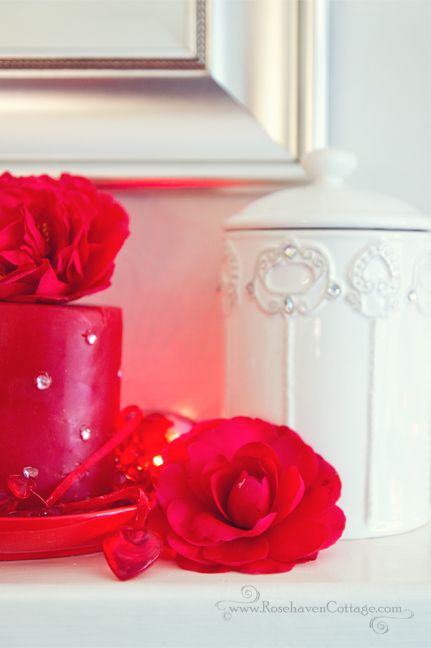
In our mild winter climate, February also brings the blooming of the camellia bushes. Growing on the sheltered north side of our house, the camellias have grown over the past 12 years with some having branches that touch the underside of the eaves. They set buds in November. Then we sit and wait with great anticipation until they begin blooming some time in late January or early February. February has become "camellia season" for me.
I sometimes like to bring two or three blooms inside and float them in low dishes filled with water. They look like Valentines from Nature herself. The rest of the blooms I leave outside where we can see them through the windows on that side of the house. Even on a rainy day, they brighten and cheer the winter landscape. Cool and velvety-soft to the touch, the brilliant red and pink petals of the camellia blossoms stay on the bushes about as long as roses stay on the bush. Eventually the camellia petals fall to the ground carpeting the ground under the bushes as if a bride is expected to walk down the aisle there. It is dazzling.
I'm so happy camellia season is here once again.
The first signs of spring are appearing in the garden
Around the base of the olive tree, the jonquils have sent up their spring-green spears and tiny teacup-blooms. Just a few are opening. More will probably open if we get the rain that is forecast for tomorrow. We've had a nice rainy season thus far so the jonquils have a beautiful green backdrop of winter grasses and oxalis that showcase the blooms wonderfully.
The loquat tree is sending out its second set of blooms this winter. The first set of blooms were too early in January and ended up shriveled and frostbitten. I was afraid that meant no loquats this year, but apparently the loquat has a back-up plan in place--making my concern was unnecessary.
Every year nature teaches me a little bit more about resiliency and just "going with the flow". The loquat was the first to teach me this year.
Nestled among the brown stems of dormant water iris, garlic and canna lilies, a brilliant (and somewhat tattered) gazania is blooming near the edge of the pond. Every year I watch it do this in the depths of January... every year. I don't know why. It just does. Consistent, resilient, strong and determined this 10+ year old gazania plant has taught and continues to teach me many lessons if I am quiet enough to hear them.
Only another week or two and I know I'll be spotting the first almond tree in bloom on one of our surrounding hills. Then I'll know that spring has truly arrived. In the meantime, I find little harbingers of spring nestled in corners of our little garden... and each one makes me smile.
Thoughts on crossing the threshold into the world of bifocals
About 6 months ago I noticed that my glasses were "off" and I wasn't seeing things as clearly as I used to. At first I thought it was just caused by scratches on the poor lenses that have taken a beating over the years. Then I realized that more and more I was having to take my glasses off to see things I wanted to read up close. Hubby (who has needed bifocals for a couple of years now) would tease me about the fact that my eyes were catching up to his and I probably needed bifocals. I'm usually more practical than vain, so the thought of needing bifocals didn't bug me so much. But I wasn't doing the typical arm's-length-stretch to read things like I see most people do when they need bifocals.
We had to wait for some switchovers in our healthcare plan before we could go see an eye doctor. As soon as the new healthcare coverage kicked in at the first of the year, we made appointments.
It turned out that my puzzlement was warranted. The eye doctor told me that although my distance vision needed more correction than before and I needed some magnification for reading, my mid-range vision didn't need any correction at all. That's why I was having to take my glasses off when I was working on the computer or reading my iPad or iPhone. Aha!
Hubby and I went off on a quest to find frames for each of us. We both like quirky looking frames. I wanted some that looked "a-dork-able". He wanted some that looked completely vintage. We both found frames that we loved and ordered them with our new prescriptions for bifocals.
I just got my new glasses yesterday. The bifocals will take some getting used to. Hopefully, I adapt to them sooner rather than later.
I guess I'm officially middle-aged now that I'm wearing bifocals. I don't know how I really feel about it.
Does anyone else have thoughts on when you first had to admit your eyes were getting older?
![]() |
| Just in case anyone wanted to see what they look like on me |
I think I can safely dub this winter "The Winter of Citrus"
Our crop off our dwarf citrus trees has been incredible! The Kinnow mandarin, Morro blood orange and Lane Late orange have all been little champions. Each of the diminutive trees has performed in a stellar way and given us the juiciest and sweetest bounty. The Lane Late gave me it's first proper fruit with an orange the size of a softball. Hubby and I shared it with each of us eating a juicy and scrumptious half.
There is something about those beautiful orange colored rinds in the depths of winter's chill that is heartwarming and worthy of being photographed... again and again and again. It's like the sun got placed right in my garden when I need it most to counter my SAD (Seasonal Affective Disorder). So far my SAD has been very low-key this year. Maybe I have the citrus to thank in part for that.
![]() |
| Available in fine art prints by clicking on the image above |
A couple of days ago on my daily garden stroll, I was pleased to find that the Washington navel orange tree we put in a couple of years ago is covered with pure white buds ready to burst open into sweet and heady-fragranced blossoms. I'm on "orange blossom watch" every day as I anticipate them opening. I think I will try my hand at doing some manual pollination with a Q-tip this year to try and ensure that I get at least 1 or 2 oranges off the tree. It has yet to produce its first fruit as it's been trying to get settled. The weather is rather chilly for most pollinators to be out and about much so I think I'll need to help it along.
The navel orange tree isn't a dwarf and I hope that it will eventually reach it's expected height of 20-30 feet tall. For now it's only a little bigger than the dwarf trees at about 4 feet tall. I think at this height it may have a hard time supporting more than just a few fruits. We'll see.
For now, we still have some mandarins left on the tree--late ripeners that I'll pick and enjoy as soon as they feel just right when I give them a gentle squeeze. And we also have a load of Eureka lemons on the semi-dwarf tree in the center of the garden. Those can stay on the branch and be picked as needed (which Hubby does often for cooking).
Now I'm craving some lemon chicken. "Oh Hubby..."
Spotting two new birds I've never seen in person... a great way to end 2012, in my opinion
When December rolls around, I begin to fill the bird feeders. I don't have to until then. The birds are busy feeding on bugs and seeds from the rest of the garden. But about December is when the bugs go into hiding and the seeds from the plants get sparse. So the sunflower seeds go into seed feeders and suet goes into the suet feeders.
It is about this time of year that I often see birds I'm not used to seeing here. Because our winters are milder than only just a few hundred miles north, we get visitors that we don't see the rest of the year.
Today, I got the treat of getting to see and photograph two new types of birds that I haven't seen in person before. It was a real treat to see these rare visitors.
Yesterday, when I was sitting on the deck getting sun and giving the garden kitty lots of affection and attention, I spotted a bird and couldn't figure out what it was. I didn't have my camera with me so I had to go off of memory when hunting through my Birds of Northern California book. I couldn't find anything that looked like what I had seen. I felt like one of those people that claims to have seen Bigfoot but didn't have their camera with them. It was maddening.
Today I went out to get my bit of sun for the day (and give attention to the garden kitty) and remembered that I should have my camera with me. So I went back inside, mounted the telephoto lens on my camera body, and headed back out. It wasn't any time at all before I was rewarded with a sighting of a white-breasted nuthatch climbing around on things in a gravity-defying way. I was so excited! On the packaging of the suet I buy, there's a picture of a nuthatch. But I've never seen a nuthatch in my garden... until today!
Then as if on cue, the same kind of mystery bird I saw yesterday flew down and landed not far from the nuthatch on the fence. They were both negotiating who would be eating next from the cylindrical suet feeder with the "peanut butter and jelly" flavored suet (the exact suet with the nuthatch on the packaging). I was so excited! I would finally have photographic evidence of this mystery bird. Hallelujah! I wasn't in the "Bigfoot camp" anymore!
After I uploaded the shots to my computer, I started hunting through my Birds of Northern California book again. It was maddening. Again, I couldn't find one like it. It's often hard to identify birds from my book because the pictures are artist renderings and not photos. Then I spotted one that might be a possibility. I googled the name "yellow-rumped warbler". Hazah! That was it! The photos on the internet look very different than the one artist rendering in the book. I'm surprised I figured it out.
I read about the yellow-rumped warbler and my book says, "Although [they] do not breed in northern California, they are commonly seen along the Pacific coast in the migration and during winter." Okay! That explains my sighting perfectly.
What a great way to finish out the year, I say.
Wishing you all a very Merry Christmas!
Each and every one of you are important to me and Hubby. We send you the very best wishes for a Merry Christmas full of love and laughter and the making of happy memories.
Subscribe to:
Posts (Atom)
All images, photos and writing


